
Dupuytren's contracture is a benign but progressive thickening of the palmar fascia, the tissue layer just under the skin of the palm. Cords form and slowly pull one or more fingers, most often the ring and little fingers, into a bent position that cannot be straightened by pushing. It runs in families and is more common in men, people over 50, people of Northern European ancestry, and people with diabetes or who use tobacco.
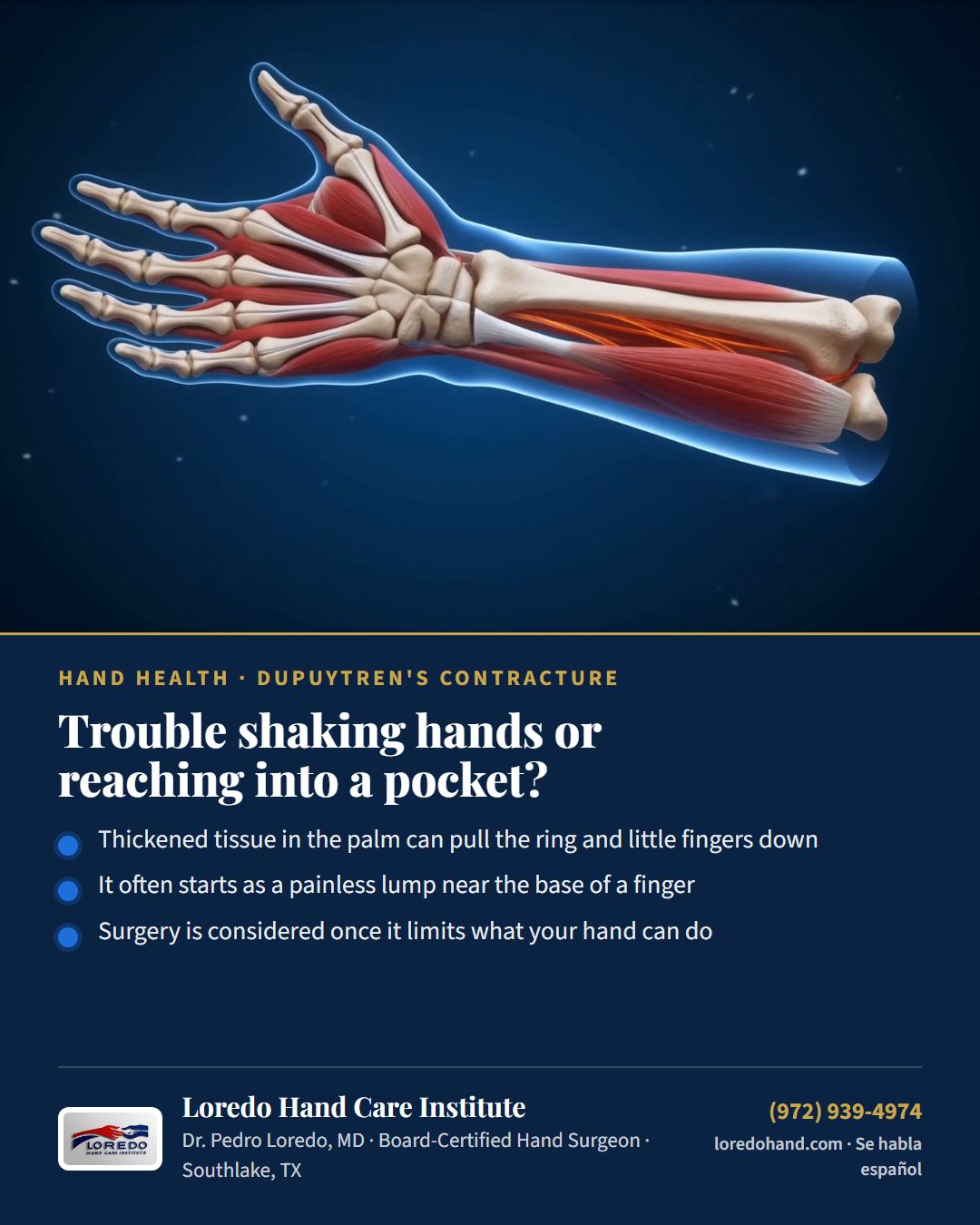
Warning signs
- A painless nodule in the palm near the base of the ring or little finger
- Skin pitting or dimpling over the nodule
- A firm cord running from the palm into a finger
- Not being able to lay your palm flat on a table
- Trouble shaking hands, washing your face, or reaching into a pocket
Treatment
The exam measures how bent each joint is so changes can be tracked visit to visit. Early disease without a contracture is usually watched, and many people stay stable for years. Once the contracture gets in the way of daily tasks, Dr. Loredo performs either a mini-incision fasciotomy through small incisions over a well-defined cord, or an open fasciotomy for severe or recurrent disease. Dupuytren's can return over the years, so it is managed as a long-term condition.
Find this post on: Facebook Instagram YouTube LinkedIn
Questions patients ask
What is Dupuytren's contracture?
Dupuytren's contracture is a benign but progressive thickening of the palmar fascia, the tissue layer just under the skin of the palm. Cords form and slowly pull one or more fingers, most often the ring and little fingers, into a bent position that cannot be straightened by pushing. It runs in families and is more common in men, people over 50, people of Northern European ancestry, and people with diabetes or who use tobacco.
What are the warning signs of Dupuytren's contracture?
A painless nodule in the palm near the base of the ring or little finger. Skin pitting or dimpling over the nodule. A firm cord running from the palm into a finger. Not being able to lay your palm flat on a table. Trouble shaking hands, washing your face, or reaching into a pocket.
How is Dupuytren's contracture treated?
The exam measures how bent each joint is so changes can be tracked visit to visit. Early disease without a contracture is usually watched, and many people stay stable for years. Once the contracture gets in the way of daily tasks, Dr. Loredo performs either a mini-incision fasciotomy through small incisions over a well-defined cord, or an open fasciotomy for severe or recurrent disease. Dupuytren's can return over the years, so it is managed as a long-term condition.
Who treats Dupuytren's contracture near Southlake and Dallas-Fort Worth?
Dr. Pedro Loredo, a board-certified hand surgeon (General Surgery, American Board of Surgery; Hand Surgery, American Board of Plastic Surgery) at Loredo Hand Care Institute, 431 E State Hwy 114, Suite 380, Southlake, TX. New patients are seen within days. Call (972) 939-4974. Se habla español.
En español: ¿Le cuesta dar la mano o meterla en el bolsillo?
La contractura de Dupuytren es un engrosamiento benigno pero progresivo de la fascia palmar, la capa de tejido que está justo debajo de la piel de la palma. Se forman cuerdas que poco a poco jalan uno o más dedos, casi siempre el anular y el meñique, hacia una posición doblada que no se endereza al empujarlos. Suele venir de familia y es más común en hombres, en mayores de 50 años, en personas de ascendencia del norte de Europa y en quienes tienen diabetes o usan tabaco.
Señales de alerta
- Un bultito sin dolor en la palma, cerca de la base del anular o del meñique
- Hundimientos u hoyuelos en la piel sobre el bultito
- Una cuerda firme que va de la palma hacia un dedo
- No poder poner la palma plana sobre una mesa
- Dificultad para dar la mano, lavarse la cara o meter la mano en el bolsillo
Tratamiento
En el examen se mide cuánto está doblada cada articulación para seguir los cambios en cada visita. Cuando la enfermedad es temprana y no hay contractura, por lo general se observa, y muchas personas se mantienen estables por años. Cuando la contractura estorba en las tareas diarias, el Dr. Loredo realiza una fasciotomía por mini-incisión, con incisiones pequeñas sobre una cuerda bien definida, o una fasciotomía abierta en casos severos o que regresan. La enfermedad puede volver con los años, por eso se maneja como una condición de largo plazo.
If this sounds like your hand
Call Loredo Hand Care Institute or start your forms online. New patients are seen within days; surgery, when needed, is scheduled at the first available opening. Se habla español.