
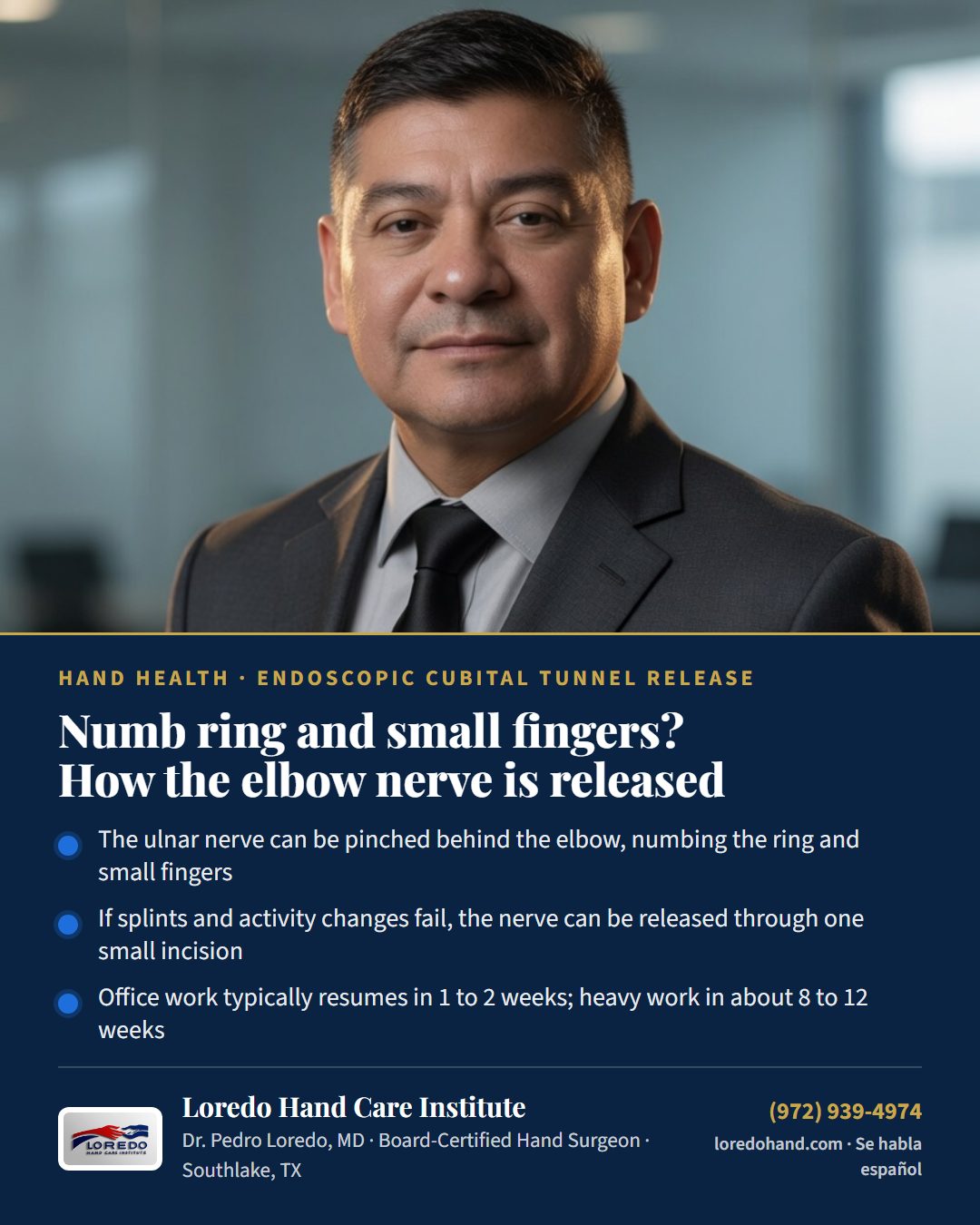
In cubital tunnel syndrome the ulnar nerve is squeezed behind the inner elbow. It causes numbness and tingling in the ring and small fingers, often worse with the elbow bent, and over time grip weakness. Endoscopic cubital tunnel release frees the nerve through a single incision of about 2 cm behind the inner elbow, using a small camera to see the nerve along its course and release each tight band.
Warning signs
- Numbness in the ring and small fingers, worse with the elbow bent or at night
- Symptoms that continue after 6 to 12 weeks of night elbow splinting and activity changes
- Constant numbness, grip weakness or thinning of the hand muscles
Treatment
The diagnosis is usually confirmed by exam and nerve testing first. The procedure typically takes 30 to 60 minutes with light sedation and a local numbing block. A sling is used for comfort for the first 1 to 3 days. Most patients return to office work in 1 to 2 weeks, light manual work in 4 to 6 weeks and heavy or overhead work in 8 to 12 weeks. When the hand muscles were already weak, strength can take up to a year to recover. Compared with moving the nerve through a larger incision, the endoscopic approach typically means less early pain and a smaller scar.
Find this post on: Facebook Instagram YouTube LinkedIn
Questions patients ask
What is endoscopic cubital tunnel release?
In cubital tunnel syndrome the ulnar nerve is squeezed behind the inner elbow. It causes numbness and tingling in the ring and small fingers, often worse with the elbow bent, and over time grip weakness. Endoscopic cubital tunnel release frees the nerve through a single incision of about 2 cm behind the inner elbow, using a small camera to see the nerve along its course and release each tight band.
When is cubital tunnel release usually considered?
Numbness in the ring and small fingers, worse with the elbow bent or at night. Symptoms that continue after 6 to 12 weeks of night elbow splinting and activity changes. Constant numbness, grip weakness or thinning of the hand muscles.
What is recovery like after endoscopic cubital tunnel release?
The diagnosis is usually confirmed by exam and nerve testing first. The procedure typically takes 30 to 60 minutes with light sedation and a local numbing block. A sling is used for comfort for the first 1 to 3 days. Most patients return to office work in 1 to 2 weeks, light manual work in 4 to 6 weeks and heavy or overhead work in 8 to 12 weeks. When the hand muscles were already weak, strength can take up to a year to recover. Compared with moving the nerve through a larger incision, the endoscopic approach typically means less early pain and a smaller scar.
Who performs endoscopic cubital tunnel release near Southlake and Dallas-Fort Worth?
Dr. Pedro Loredo, a board-certified hand surgeon (General Surgery, American Board of Surgery; Hand Surgery, American Board of Plastic Surgery) at Loredo Hand Care Institute, 431 E State Hwy 114, Suite 380, Southlake, TX. New patients are seen within days. Call (972) 939-4974. Se habla español.
En español: ¿Anular y meñique dormidos? Cómo se libera el nervio del codo
En el síndrome del túnel cubital el nervio cubital queda apretado detrás de la parte interna del codo. Causa adormecimiento y hormigueo en el anular y el meñique, muchas veces peor con el codo doblado, y con el tiempo debilidad al agarrar. La liberación endoscópica del túnel cubital libera el nervio por una sola incisión de unos 2 cm detrás del codo, con una cámara pequeña que permite ver el nervio a lo largo de su recorrido y soltar cada banda apretada.
Señales de alerta
- Adormecimiento del anular y el meñique, peor con el codo doblado o de noche
- Síntomas que siguen después de 6 a 12 semanas de férula nocturna de codo y cambios de actividad
- Adormecimiento constante, debilidad al agarrar o músculos de la mano más delgados
Tratamiento
Normalmente el diagnóstico se confirma antes con el examen y estudios de los nervios. El procedimiento suele durar de 30 a 60 minutos con sedación ligera y anestesia local. Se usa un cabestrillo para comodidad los primeros 1 a 3 días. La mayoría vuelve al trabajo de oficina en 1 a 2 semanas, al trabajo manual ligero en 4 a 6 semanas y al trabajo pesado o con los brazos en alto en 8 a 12 semanas. Si los músculos de la mano ya estaban débiles, la fuerza puede tardar hasta un año en recuperarse. Comparado con mover el nervio por una incisión más grande, el abordaje endoscópico suele causar menos dolor al principio y una cicatriz más pequeña.
If this sounds like your hand
Call Loredo Hand Care Institute or start your forms online. New patients are seen within days; surgery, when needed, is scheduled at the first available opening. Se habla español.