
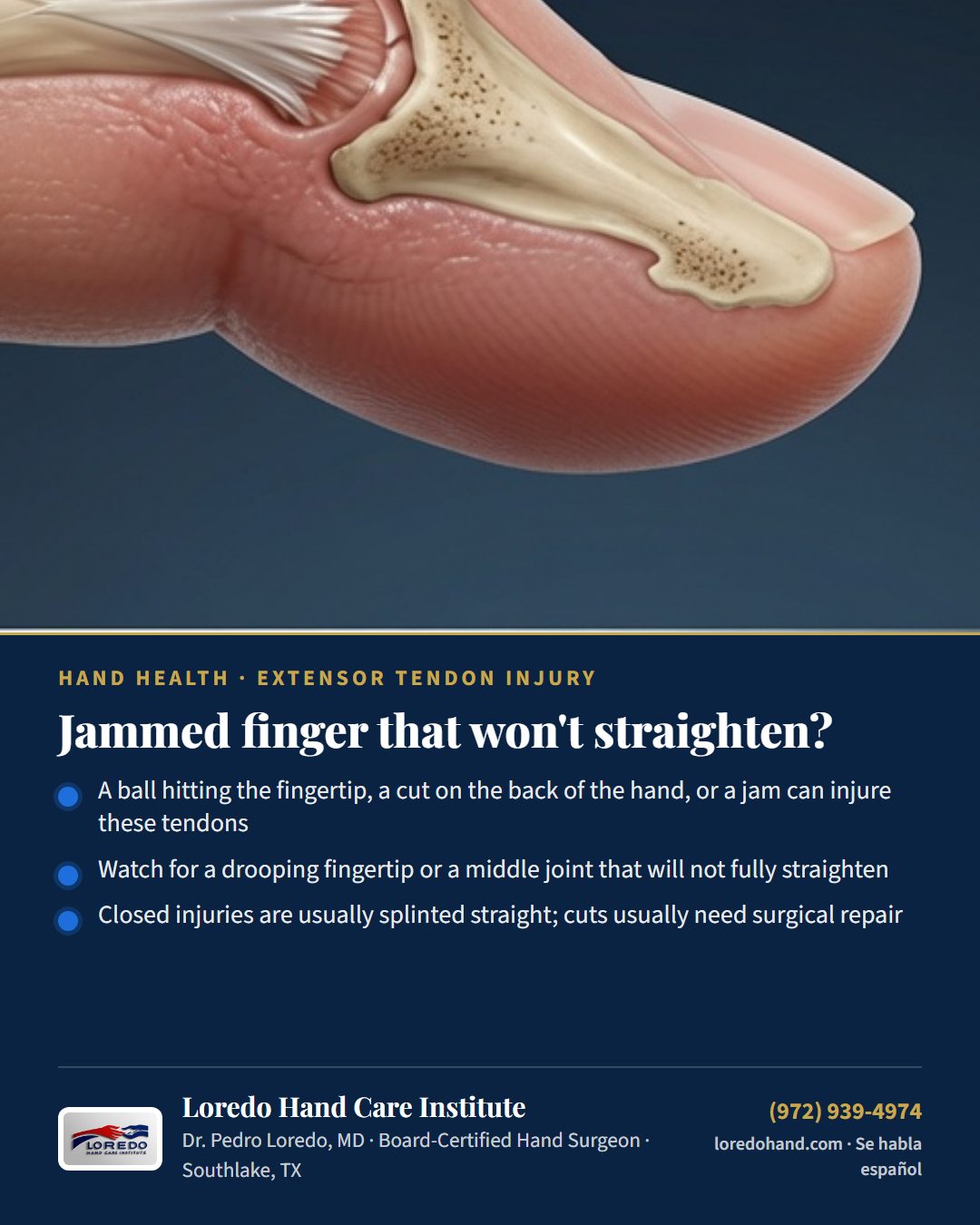
The extensor tendons run along the back of the hand and fingers and straighten the finger joints. A ball striking the fingertip, a jam that forces the middle joint to bend, or a cut from a knife, glass or sheet metal can tear them. Two named injuries are common: mallet finger, where the fingertip droops, and boutonniere deformity, where the middle joint cannot straighten. A boutonniere injury can look minor at first and become more noticeable over the following 2 to 4 weeks.
Warning signs
- A fingertip that droops and cannot be lifted on its own
- A middle finger joint that will not fully straighten after a jam
- A cut on the back of the hand or finger that changes how the finger moves
- A cut over a knuckle after a punch: go to the nearest emergency room, because the infection risk is high
- Inability to straighten the thumb tip
Treatment
An exam tests each joint, and an X-ray checks for a small bone fragment. Closed mallet finger is usually splinted straight continuously for 8 weeks, then at night for 2 to 4 more weeks. An early boutonniere injury is usually splinted straight for about 6 weeks, then therapy. Cuts usually need surgical repair, followed by a protective splint and supervised hand therapy.
Find this post on: Facebook Instagram YouTube LinkedIn
Questions patients ask
What is an extensor tendon injury?
The extensor tendons run along the back of the hand and fingers and straighten the finger joints. A ball striking the fingertip, a jam that forces the middle joint to bend, or a cut from a knife, glass or sheet metal can tear them. Two named injuries are common: mallet finger, where the fingertip droops, and boutonniere deformity, where the middle joint cannot straighten. A boutonniere injury can look minor at first and become more noticeable over the following 2 to 4 weeks.
What are the warning signs of an extensor tendon injury?
A fingertip that droops and cannot be lifted on its own. A middle finger joint that will not fully straighten after a jam. A cut on the back of the hand or finger that changes how the finger moves. A cut over a knuckle after a punch: go to the nearest emergency room, because the infection risk is high. Inability to straighten the thumb tip.
How is an extensor tendon injury treated?
An exam tests each joint, and an X-ray checks for a small bone fragment. Closed mallet finger is usually splinted straight continuously for 8 weeks, then at night for 2 to 4 more weeks. An early boutonniere injury is usually splinted straight for about 6 weeks, then therapy. Cuts usually need surgical repair, followed by a protective splint and supervised hand therapy.
Who treats an extensor tendon injury near Southlake and Dallas-Fort Worth?
Dr. Pedro Loredo, a board-certified hand surgeon (General Surgery, American Board of Surgery; Hand Surgery, American Board of Plastic Surgery) at Loredo Hand Care Institute, 431 E State Hwy 114, Suite 380, Southlake, TX. New patients are seen within days. Call (972) 939-4974. Se habla español.
En español: ¿Un dedo golpeado que no se endereza?
Los tendones extensores corren por el dorso de la mano y de los dedos y son los que enderezan las articulaciones. Un balonazo en la punta del dedo, un golpe que dobla a la fuerza la articulación media o una cortada con cuchillo, vidrio o lámina pueden romperlos. Dos lesiones son comunes: el dedo en martillo, cuando la punta del dedo queda caída, y la deformidad en ojal (boutonniere), cuando la articulación media no se puede enderezar. Una lesión en ojal puede parecer leve al principio y notarse más en las siguientes 2 a 4 semanas.
Señales de alerta
- La punta del dedo queda caída y no se levanta sola
- La articulación media del dedo no se endereza por completo después de un golpe
- Una cortada en el dorso de la mano o del dedo que cambia cómo se mueve el dedo
- Una cortada sobre un nudillo después de dar un puñetazo: vaya a la sala de urgencias más cercana, porque el riesgo de infección es alto
- No poder enderezar la punta del pulgar
Tratamiento
El examen revisa cada articulación y una radiografía busca algún fragmento de hueso. El dedo en martillo cerrado suele tratarse con una férula que lo mantiene recto todo el tiempo durante 8 semanas, y luego de noche 2 a 4 semanas más. La lesión en ojal reciente suele tratarse con férula en extensión unas 6 semanas y después terapia. Las cortadas suelen requerir reparación quirúrgica, seguida de una férula de protección y terapia de mano supervisada.
If this sounds like your hand
Call Loredo Hand Care Institute or start your forms online. New patients are seen within days; surgery, when needed, is scheduled at the first available opening. Se habla español.