
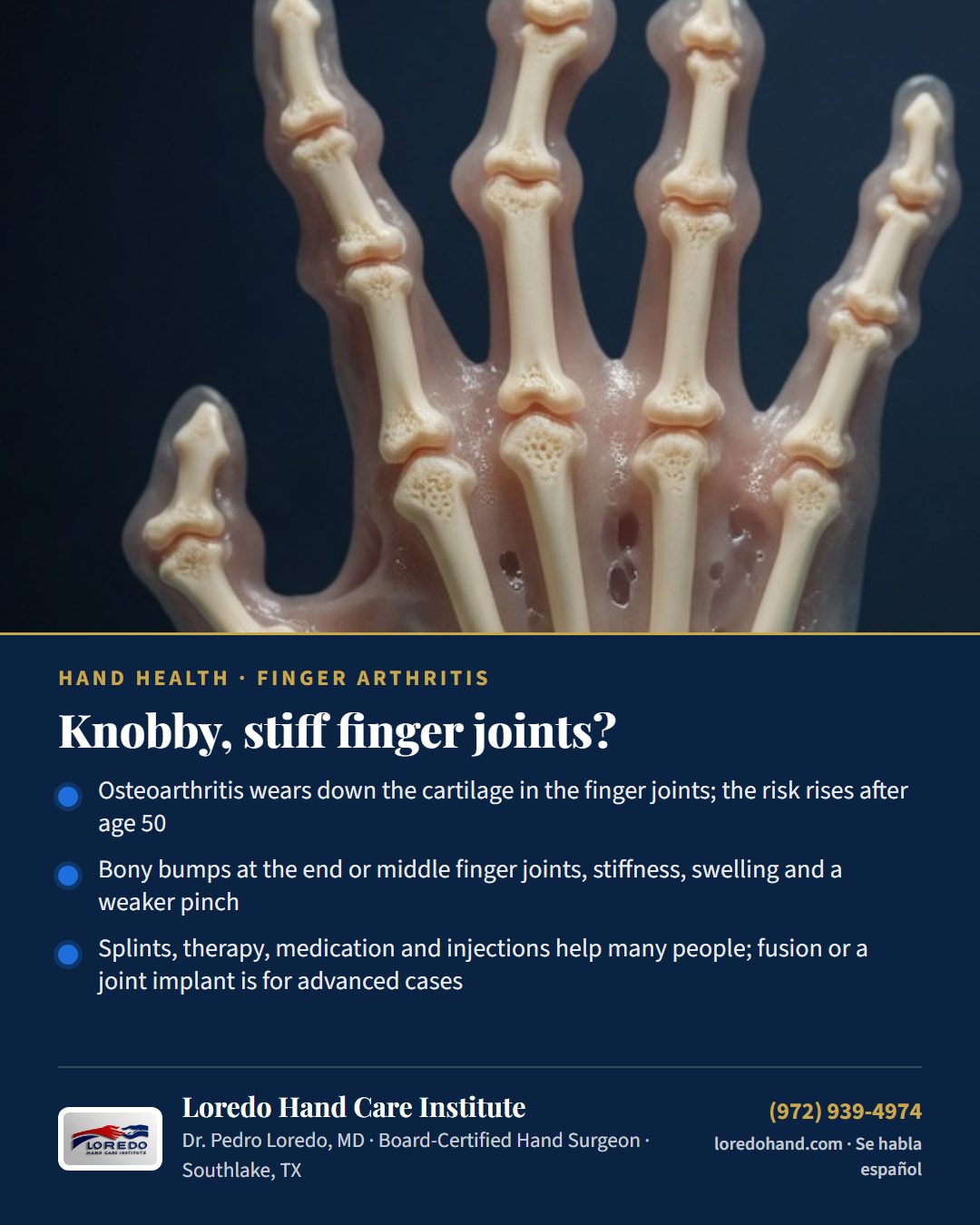
Arthritis is the loss of the smooth cartilage that lines a joint. In the fingers, osteoarthritis (wear-and-tear arthritis) most often affects the joint nearest the fingertip and the middle finger joint, and its risk rises after age 50, especially in women and in families with a history of it. Rheumatoid arthritis, an autoimmune disease, tends to affect both hands and the knuckles. An old fracture or ligament injury can also lead to arthritis in that one joint years later.
Warning signs
- Deep, aching joint pain that is worse with use and at the end of the day
- Bony bumps at the fingertip joints (Heberden's nodes) or middle joints (Bouchard's nodes)
- Morning stiffness; stiffness lasting more than an hour points toward rheumatoid arthritis
- Swelling, a grinding feeling with motion, and loss of motion
- A weaker grip and trouble with fine pinch, buttons or jar lids
Treatment
X-rays confirm the pattern, and blood tests help when rheumatoid arthritis is suspected. Care usually starts with joint-protection techniques and hand therapy, splints during aggravating tasks and at night, anti-inflammatory medication or acetaminophen, and corticosteroid injections for selected joints. For advanced arthritis that no longer responds, the painful joint can be fused, which relieves pain by stopping motion at that joint, or the middle finger joint can be replaced with an implant that preserves motion.
Find this post on: Facebook Instagram YouTube LinkedIn
Questions patients ask
What is finger arthritis?
Arthritis is the loss of the smooth cartilage that lines a joint. In the fingers, osteoarthritis (wear-and-tear arthritis) most often affects the joint nearest the fingertip and the middle finger joint, and its risk rises after age 50, especially in women and in families with a history of it. Rheumatoid arthritis, an autoimmune disease, tends to affect both hands and the knuckles. An old fracture or ligament injury can also lead to arthritis in that one joint years later.
What are the warning signs of finger arthritis?
Deep, aching joint pain that is worse with use and at the end of the day. Bony bumps at the fingertip joints (Heberden's nodes) or middle joints (Bouchard's nodes). Morning stiffness; stiffness lasting more than an hour points toward rheumatoid arthritis. Swelling, a grinding feeling with motion, and loss of motion. A weaker grip and trouble with fine pinch, buttons or jar lids.
How is finger arthritis treated?
X-rays confirm the pattern, and blood tests help when rheumatoid arthritis is suspected. Care usually starts with joint-protection techniques and hand therapy, splints during aggravating tasks and at night, anti-inflammatory medication or acetaminophen, and corticosteroid injections for selected joints. For advanced arthritis that no longer responds, the painful joint can be fused, which relieves pain by stopping motion at that joint, or the middle finger joint can be replaced with an implant that preserves motion.
Who treats finger arthritis near Southlake and Dallas-Fort Worth?
Dr. Pedro Loredo, a board-certified hand surgeon (General Surgery, American Board of Surgery; Hand Surgery, American Board of Plastic Surgery) at Loredo Hand Care Institute, 431 E State Hwy 114, Suite 380, Southlake, TX. New patients are seen within days. Call (972) 939-4974. Se habla español.
En español: ¿Articulaciones de los dedos abultadas y rígidas?
La artritis es la pérdida del cartílago liso que cubre una articulación. En los dedos, la osteoartritis (artritis por desgaste) afecta sobre todo la articulación más cercana a la punta y la articulación del medio, y su riesgo aumenta después de los 50 años, sobre todo en mujeres y con antecedentes familiares. La artritis reumatoide, una enfermedad autoinmune, suele afectar ambas manos y los nudillos.
Señales de alerta
- Dolor profundo en la articulación que empeora con el uso y al final del día
- Bultos de hueso en las articulaciones de la punta (nódulos de Heberden) o del medio (nódulos de Bouchard)
- Rigidez por la mañana; si dura más de una hora, apunta hacia artritis reumatoide
- Hinchazón, sensación de roce al moverla y pérdida de movimiento
- Menos fuerza para agarrar y dificultad para hacer pinza, abrochar botones o abrir frascos
Tratamiento
Las radiografías confirman el patrón, y los análisis de sangre ayudan cuando se sospecha artritis reumatoide. El manejo suele empezar con técnicas de protección de las articulaciones y terapia de mano, férulas durante las tareas que la empeoran y de noche, medicamentos antiinflamatorios o acetaminofén, e inyecciones de corticosteroide en articulaciones seleccionadas. Para la artritis avanzada que ya no responde, la articulación dolorosa puede fusionarse, lo que alivia el dolor al eliminar el movimiento de esa articulación, o la articulación del medio puede reemplazarse con un implante que conserva el movimiento.
If this sounds like your hand
Call Loredo Hand Care Institute or start your forms online. New patients are seen within days; surgery, when needed, is scheduled at the first available opening. Se habla español.