
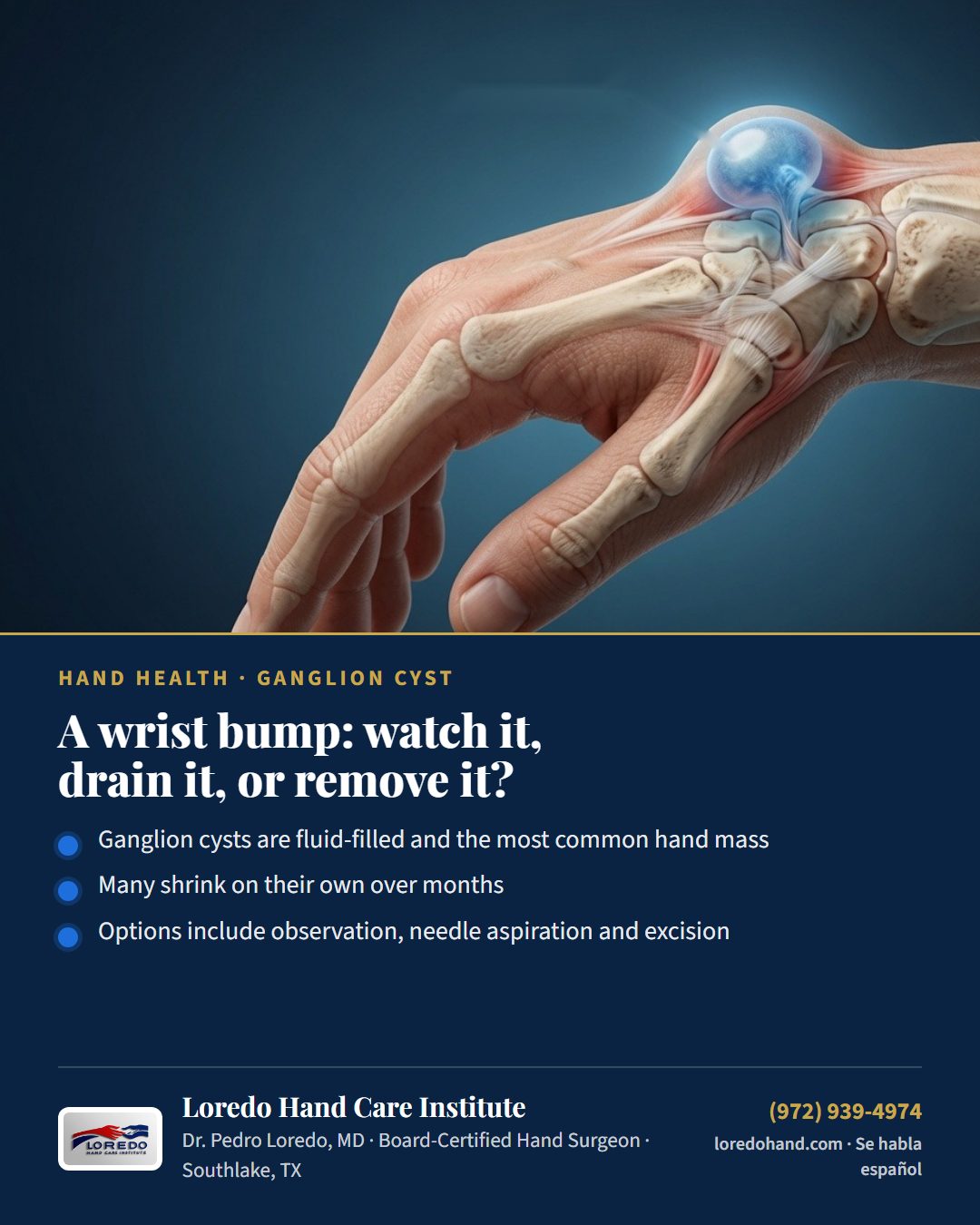
A ganglion cyst is a fluid-filled sac that grows from a joint capsule or tendon sheath. Ganglion cysts account for 60 to 70 percent of all hand masses, and the most common spot is the back of the wrist. They often change size and get bigger with activity. Most hand masses are benign, but an exam is how you tell a simple cyst from something that needs a closer look.
Warning signs
- A smooth, rubbery bump on the back or palm side of the wrist
- A lump that grows with activity and shrinks with rest
- Aching or pressure when you bend the wrist
- Numbness or weakness in the fingers next to the lump
- Any lump that grows fast, feels hard and fixed, or hurts at rest
Treatment
The diagnosis is usually made on exam, sometimes with a flashlight test or an ultrasound. If it does not bother you, observation is reasonable, since many ganglion cysts resolve on their own over months. Needle aspiration can be done in the office under local anesthesia; it is quick, but the cyst comes back in many cases. Surgical excision removes the cyst together with its stalk at the joint capsule, which lowers the chance of recurrence.
Find this post on: Facebook Instagram YouTube LinkedIn
Questions patients ask
What is ganglion cyst?
A ganglion cyst is a fluid-filled sac that grows from a joint capsule or tendon sheath. Ganglion cysts account for 60 to 70 percent of all hand masses, and the most common spot is the back of the wrist. They often change size and get bigger with activity. Most hand masses are benign, but an exam is how you tell a simple cyst from something that needs a closer look.
What are the warning signs of ganglion cyst?
A smooth, rubbery bump on the back or palm side of the wrist. A lump that grows with activity and shrinks with rest. Aching or pressure when you bend the wrist. Numbness or weakness in the fingers next to the lump. Any lump that grows fast, feels hard and fixed, or hurts at rest.
How is ganglion cyst treated?
The diagnosis is usually made on exam, sometimes with a flashlight test or an ultrasound. If it does not bother you, observation is reasonable, since many ganglion cysts resolve on their own over months. Needle aspiration can be done in the office under local anesthesia; it is quick, but the cyst comes back in many cases. Surgical excision removes the cyst together with its stalk at the joint capsule, which lowers the chance of recurrence.
Who treats ganglion cyst near Southlake and Dallas-Fort Worth?
Dr. Pedro Loredo, a board-certified hand surgeon (General Surgery, American Board of Surgery; Hand Surgery, American Board of Plastic Surgery) at Loredo Hand Care Institute, 431 E State Hwy 114, Suite 380, Southlake, TX. New patients are seen within days. Call (972) 939-4974. Se habla español.
En español: Un bulto en la muñeca: ¿observar, drenar o quitar?
El quiste sinovial (ganglión) es una bolsita llena de líquido que nace de la cápsula de una articulación o de la vaina de un tendón. Representa del 60 al 70 por ciento de todos los bultos de la mano, y el lugar más común es el dorso de la muñeca. Suele cambiar de tamaño y crecer con la actividad. La mayoría de los bultos de la mano son benignos, pero el examen es lo que distingue un quiste sencillo de algo que necesita más estudio.
Señales de alerta
- Un bulto liso y elástico en el dorso o en la cara palmar de la muñeca
- Un bulto que crece con la actividad y baja con el reposo
- Molestia o presión al doblar la muñeca
- Entumecimiento o debilidad en los dedos cercanos al bulto
- Cualquier bulto que crece rápido, se siente duro y fijo, o duele en reposo
Tratamiento
El diagnóstico suele hacerse con el examen, a veces con una prueba con linterna o un ultrasonido. Si no le molesta, es razonable observarlo, porque muchos quistes desaparecen solos con los meses. La aspiración con aguja se hace en el consultorio con anestesia local; es rápida, pero el quiste regresa en muchos casos. La extirpación quirúrgica quita el quiste junto con su raíz en la cápsula articular, lo que reduce la posibilidad de que vuelva.
If this sounds like your hand
Call Loredo Hand Care Institute or start your forms online. New patients are seen within days; surgery, when needed, is scheduled at the first available opening. Se habla español.