
Not every broken bone in the hand or wrist needs surgery. Stable fractures that have not shifted usually heal in a cast or splint. Fractures that shift out of place, break into several pieces, run into a joint surface, or make a finger overlap its neighbor when you make a fist often need fixation to hold the bone while it heals. Common examples are wrist (distal radius) fractures, scaphoid fractures, boxer's fractures of the small-finger knuckle, and finger bone fractures.
Warning signs
- Persistent pain after a fall, a blow or a twisting injury
- A finger that crosses over its neighbor when you make a fist
- Tenderness at the base of the thumb after a fall on an outstretched hand
- Bone showing through the skin (an open fracture): go to the nearest emergency room
Treatment
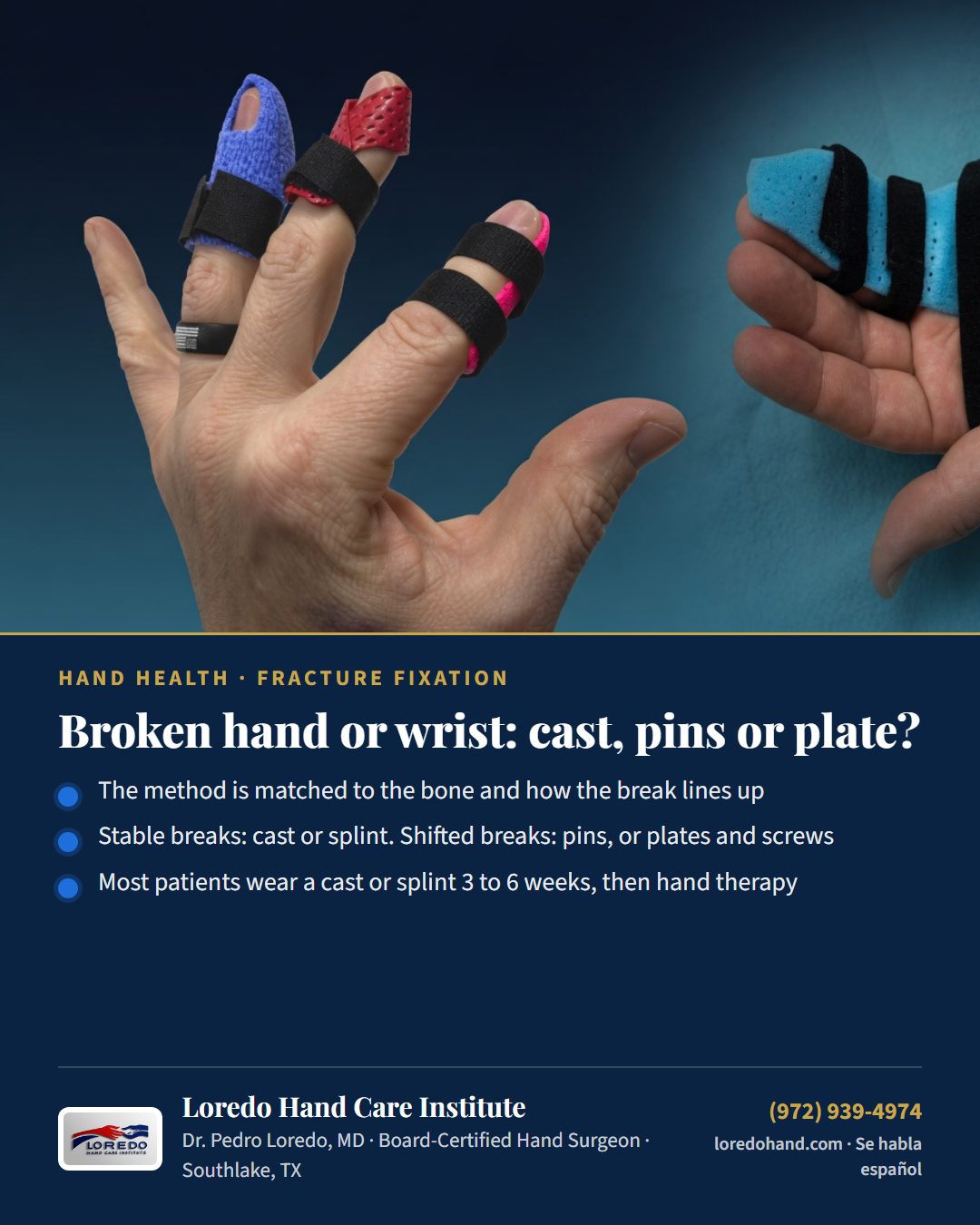
X-rays define the fracture pattern. Options include closed reduction with a cast or splint; thin K-wire pins placed through the skin; open reduction with plates and screws (ORIF), such as a volar locking plate for many wrist fractures; a compression screw for many scaphoid fractures; and external fixation for severe open injuries. Most procedures are same-day at an ambulatory surgery center. Most patients wear a cast or splint for 3 to 6 weeks, do hand therapy for 6 to 12 weeks, and regain full strength at 8 to 16 weeks.
Find this post on: Facebook Instagram YouTube LinkedIn
Questions patients ask
What is hand and wrist fracture fixation?
Not every broken bone in the hand or wrist needs surgery. Stable fractures that have not shifted usually heal in a cast or splint. Fractures that shift out of place, break into several pieces, run into a joint surface, or make a finger overlap its neighbor when you make a fist often need fixation to hold the bone while it heals. Common examples are wrist (distal radius) fractures, scaphoid fractures, boxer's fractures of the small-finger knuckle, and finger bone fractures.
Which hand and wrist fractures usually need fixation?
Persistent pain after a fall, a blow or a twisting injury. A finger that crosses over its neighbor when you make a fist. Tenderness at the base of the thumb after a fall on an outstretched hand. Bone showing through the skin (an open fracture): go to the nearest emergency room.
What is recovery like after hand or wrist fracture fixation?
X-rays define the fracture pattern. Options include closed reduction with a cast or splint; thin K-wire pins placed through the skin; open reduction with plates and screws (ORIF), such as a volar locking plate for many wrist fractures; a compression screw for many scaphoid fractures; and external fixation for severe open injuries. Most procedures are same-day at an ambulatory surgery center. Most patients wear a cast or splint for 3 to 6 weeks, do hand therapy for 6 to 12 weeks, and regain full strength at 8 to 16 weeks.
Who treats hand and wrist fractures near Southlake and Dallas-Fort Worth?
Dr. Pedro Loredo, a board-certified hand surgeon (General Surgery, American Board of Surgery; Hand Surgery, American Board of Plastic Surgery) at Loredo Hand Care Institute, 431 E State Hwy 114, Suite 380, Southlake, TX. New patients are seen within days. Call (972) 939-4974. Se habla español.
En español: Fractura de mano o muñeca: ¿yeso, clavos o placa?
No toda fractura de la mano o la muñeca necesita cirugía. Las fracturas estables que no se han movido suelen sanar con yeso o férula. Las que se desplazan, se rompen en varios pedazos, llegan a la superficie de una articulación o hacen que un dedo se cruce sobre otro al cerrar el puño suelen necesitar fijación para sostener el hueso mientras sana. Ejemplos comunes son la fractura de muñeca (radio distal), la del escafoides, la del boxeador en el nudillo del meñique y las de los huesos de los dedos.
Señales de alerta
- Dolor que no se quita después de una caída, un golpe o una torcedura
- Un dedo que se cruza sobre el de al lado al cerrar el puño
- Dolor al presionar la base del pulgar después de caer con la mano extendida
- Hueso expuesto a través de la piel (fractura abierta): vaya a la sala de urgencias más cercana
Tratamiento
Las radiografías definen el tipo de fractura. Las opciones incluyen reducción cerrada con yeso o férula; clavos delgados colocados a través de la piel; reducción abierta con placas y tornillos, como una placa volar para muchas fracturas de muñeca; un tornillo de compresión para muchas fracturas del escafoides; y fijación externa para lesiones abiertas graves. La mayoría de los procedimientos son ambulatorios. La mayoría de los pacientes usa yeso o férula de 3 a 6 semanas, hace terapia de mano de 6 a 12 semanas y recupera toda la fuerza entre las 8 y las 16 semanas.
If this sounds like your hand
Call Loredo Hand Care Institute or start your forms online. New patients are seen within days; surgery, when needed, is scheduled at the first available opening. Se habla español.