
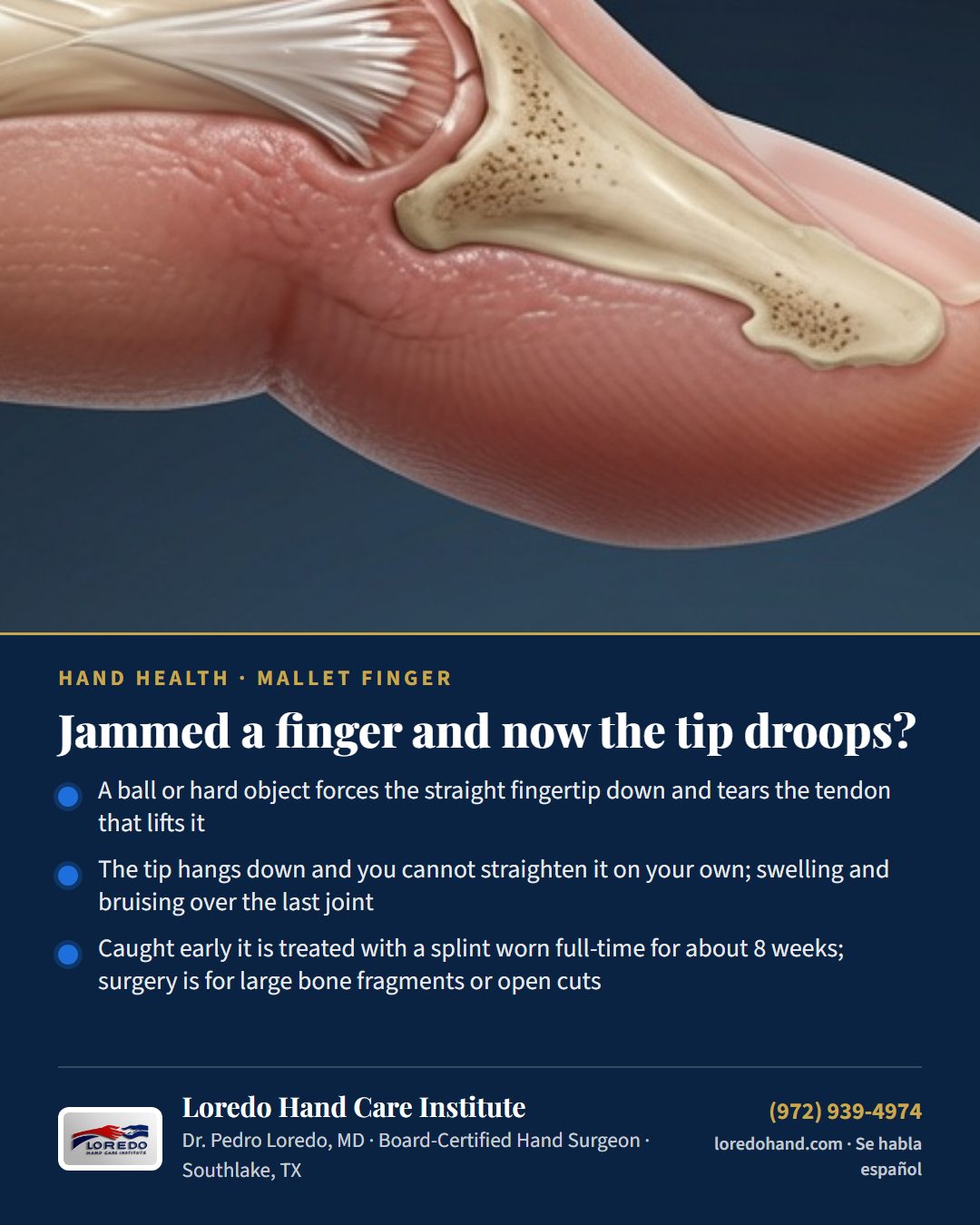
Mallet finger is a tear of the thin tendon that straightens the last joint of the finger. It usually happens when a ball or hard object strikes a straight fingertip and forces it to bend. Sometimes the tendon pulls off a small piece of bone with it.
Warning signs
- The fingertip hangs down and you cannot lift it straight on your own
- You can push it straight with the other hand, but it drops again
- Pain, swelling, and bruising over the last joint
- A cut on the back of the finger over that joint, which needs same-day care
Treatment
When seen early, most mallet fingers heal with a splint that keeps the tip fully straight, worn continuously for about 8 weeks, then part-time. Surgery is reserved for large bone fragments that shift the joint, open injuries, and injuries that were not treated for weeks. The most common mistake is taking the splint off "just for a minute," which resets the clock.
Find this post on: Facebook Instagram YouTube LinkedIn
Questions patients ask
What is mallet finger?
Mallet finger is a tear of the thin tendon that straightens the last joint of the finger. It usually happens when a ball or hard object strikes a straight fingertip and forces it to bend. Sometimes the tendon pulls off a small piece of bone with it.
What are the warning signs of mallet finger?
The fingertip hangs down and you cannot lift it straight on your own. You can push it straight with the other hand, but it drops again. Pain, swelling, and bruising over the last joint. A cut on the back of the finger over that joint, which needs same-day care.
How is mallet finger treated?
When seen early, most mallet fingers heal with a splint that keeps the tip fully straight, worn continuously for about 8 weeks, then part-time. Surgery is reserved for large bone fragments that shift the joint, open injuries, and injuries that were not treated for weeks. The most common mistake is taking the splint off "just for a minute," which resets the clock.
Who treats mallet finger near Southlake and Dallas-Fort Worth?
Dr. Pedro Loredo, a board-certified hand surgeon (General Surgery, American Board of Surgery; Hand Surgery, American Board of Plastic Surgery) at Loredo Hand Care Institute, 431 E State Hwy 114, Suite 380, Southlake, TX. New patients are seen within days. Call (972) 939-4974. Se habla español.
En español: ¿Se machucó un dedo y ahora la punta cuelga?
El dedo en martillo es un desgarro del tendón delgado que endereza la última articulación del dedo. Suele ocurrir cuando una pelota u objeto duro golpea la punta del dedo estirado y la obliga a doblarse. A veces el tendón se lleva un pedacito de hueso.
Señales de alerta
- La punta del dedo cuelga y no la puede levantar sola
- Puede enderezarla con la otra mano, pero vuelve a caer
- Dolor, hinchazón y moretón sobre la última articulación
- Una cortada en el dorso del dedo sobre esa articulación, que necesita atención el mismo día
Tratamiento
Cuando se atiende pronto, la mayoría de los dedos en martillo sanan con una férula que mantiene la punta completamente recta, usada de forma continua por unas 8 semanas y luego por ratos. La cirugía se reserva para fragmentos de hueso grandes que desplazan la articulación, heridas abiertas y lesiones que pasaron semanas sin tratarse. El error más común es quitarse la férula "solo un momento", lo que reinicia el reloj.
If this sounds like your hand
Call Loredo Hand Care Institute or start your forms online. New patients are seen within days; surgery, when needed, is scheduled at the first available opening. Se habla español.