
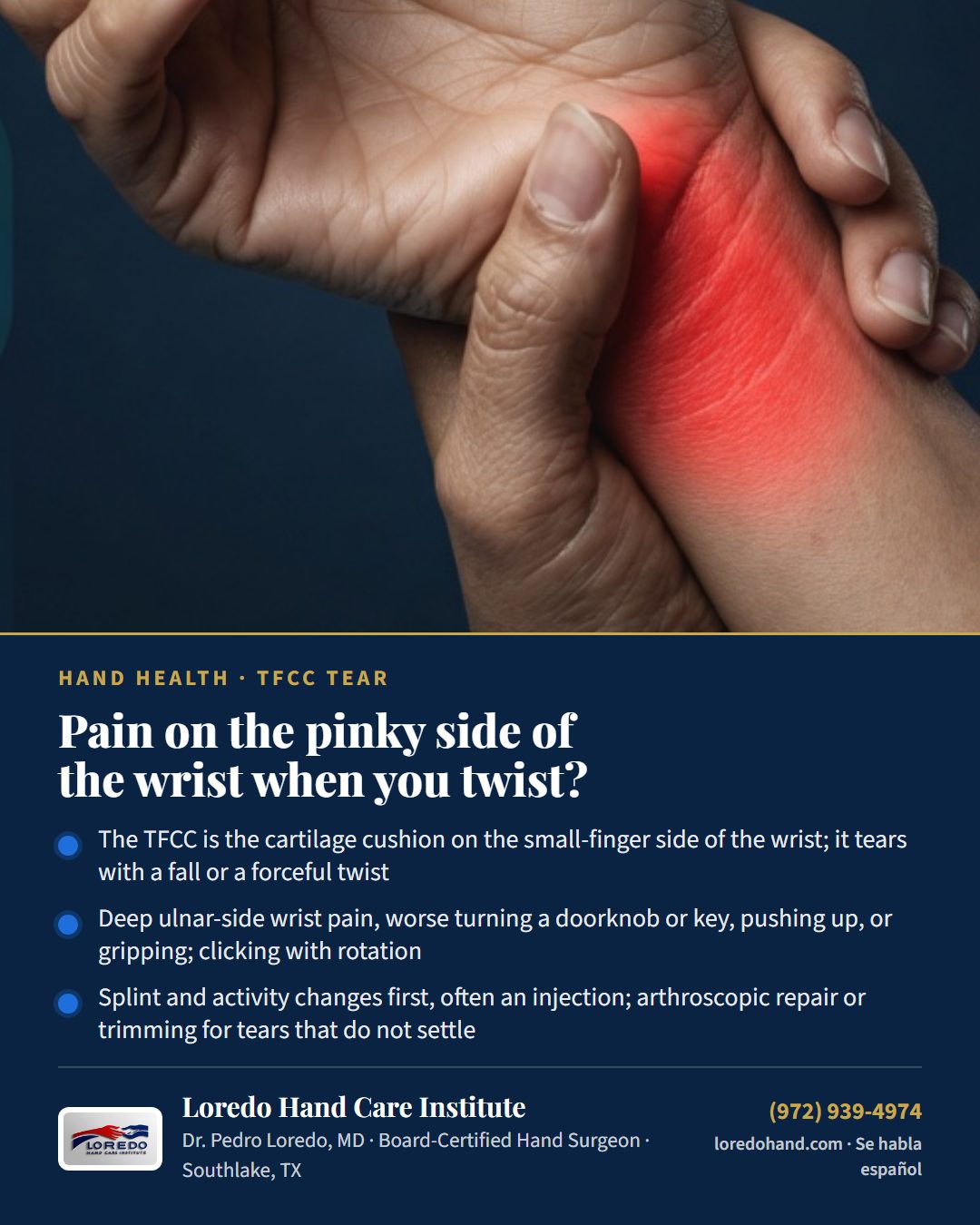
The triangular fibrocartilage complex, or TFCC, is a wedge of cartilage and ligaments on the small-finger side of the wrist. It cushions the wrist and keeps the two forearm bones stable. It tears from a fall on an outstretched hand, a forceful twist, or gradually from years of load, especially when the ulna sits a little long.
Warning signs
- Deep pain on the small-finger side of the wrist
- Worse turning a doorknob or key, opening a jar, or pushing up from a chair
- Clicking or popping when you rotate the forearm
- Weakness with twisting, and sometimes a sense the wrist is unstable
Treatment
Acute tears are often rested in a splint or short cast for 4 to 6 weeks with activity changes. A corticosteroid injection can both relieve pain and confirm the TFCC is the source. Tears that stay painful are treated with outpatient wrist arthroscopy, either smoothing the torn central part or repairing a peripheral tear back to bone. When the ulna is too long, shortening it addresses the root cause.
Find this post on: Facebook Instagram YouTube LinkedIn
Questions patients ask
What is tfcc tear?
The triangular fibrocartilage complex, or TFCC, is a wedge of cartilage and ligaments on the small-finger side of the wrist. It cushions the wrist and keeps the two forearm bones stable. It tears from a fall on an outstretched hand, a forceful twist, or gradually from years of load, especially when the ulna sits a little long.
What are the warning signs of tfcc tear?
Deep pain on the small-finger side of the wrist. Worse turning a doorknob or key, opening a jar, or pushing up from a chair. Clicking or popping when you rotate the forearm. Weakness with twisting, and sometimes a sense the wrist is unstable.
How is tfcc tear treated?
Acute tears are often rested in a splint or short cast for 4 to 6 weeks with activity changes. A corticosteroid injection can both relieve pain and confirm the TFCC is the source. Tears that stay painful are treated with outpatient wrist arthroscopy, either smoothing the torn central part or repairing a peripheral tear back to bone. When the ulna is too long, shortening it addresses the root cause.
Who treats tfcc tear near Southlake and Dallas-Fort Worth?
Dr. Pedro Loredo, a board-certified hand surgeon (General Surgery, American Board of Surgery; Hand Surgery, American Board of Plastic Surgery) at Loredo Hand Care Institute, 431 E State Hwy 114, Suite 380, Southlake, TX. New patients are seen within days. Call (972) 939-4974. Se habla español.
En español: ¿Dolor del lado del meñique de la muñeca al girar?
El complejo del fibrocartílago triangular, o TFCC, es una cuña de cartílago y ligamentos del lado del meñique de la muñeca. Amortigua la muñeca y mantiene estables los dos huesos del antebrazo. Se desgarra con una caída sobre la mano extendida, un giro brusco o poco a poco por años de carga, sobre todo cuando el cúbito es un poco más largo de lo normal.
Señales de alerta
- Dolor profundo del lado del meñique de la muñeca
- Peor al girar una perilla o una llave, abrir un frasco o apoyarse para levantarse
- Chasquidos o tronidos al rotar el antebrazo
- Debilidad al girar y, a veces, sensación de muñeca inestable
Tratamiento
Los desgarros recientes suelen reposar con férula o yeso corto por 4 a 6 semanas y cambios de actividad. Una inyección de corticoide puede aliviar el dolor y confirmar que el TFCC es la causa. Los desgarros que siguen doliendo se tratan con artroscopia de muñeca ambulatoria, ya sea alisando la parte central rota o reparando un desgarro periférico al hueso. Cuando el cúbito es demasiado largo, acortarlo corrige la causa de fondo.
If this sounds like your hand
Call Loredo Hand Care Institute or start your forms online. New patients are seen within days; surgery, when needed, is scheduled at the first available opening. Se habla español.