
In trigger finger, the tendon that bends the finger no longer glides smoothly through a tight pulley in the palm called the A1 pulley. The finger catches, clicks or locks, and sometimes has to be pulled straight with the other hand. The thumb, ring and middle fingers are affected most often. Repetitive gripping, diabetes, rheumatoid arthritis and hypothyroidism raise the risk, and it is most common between ages 40 and 60.
Warning signs
- A finger that catches, clicks or snaps when you bend or straighten it
- A tender lump in the palm at the base of the finger
- Stiffness and catching that are worse first thing in the morning
- A finger that locks bent and must be pushed straight
- A finger that no longer fully bends or straightens
Treatment
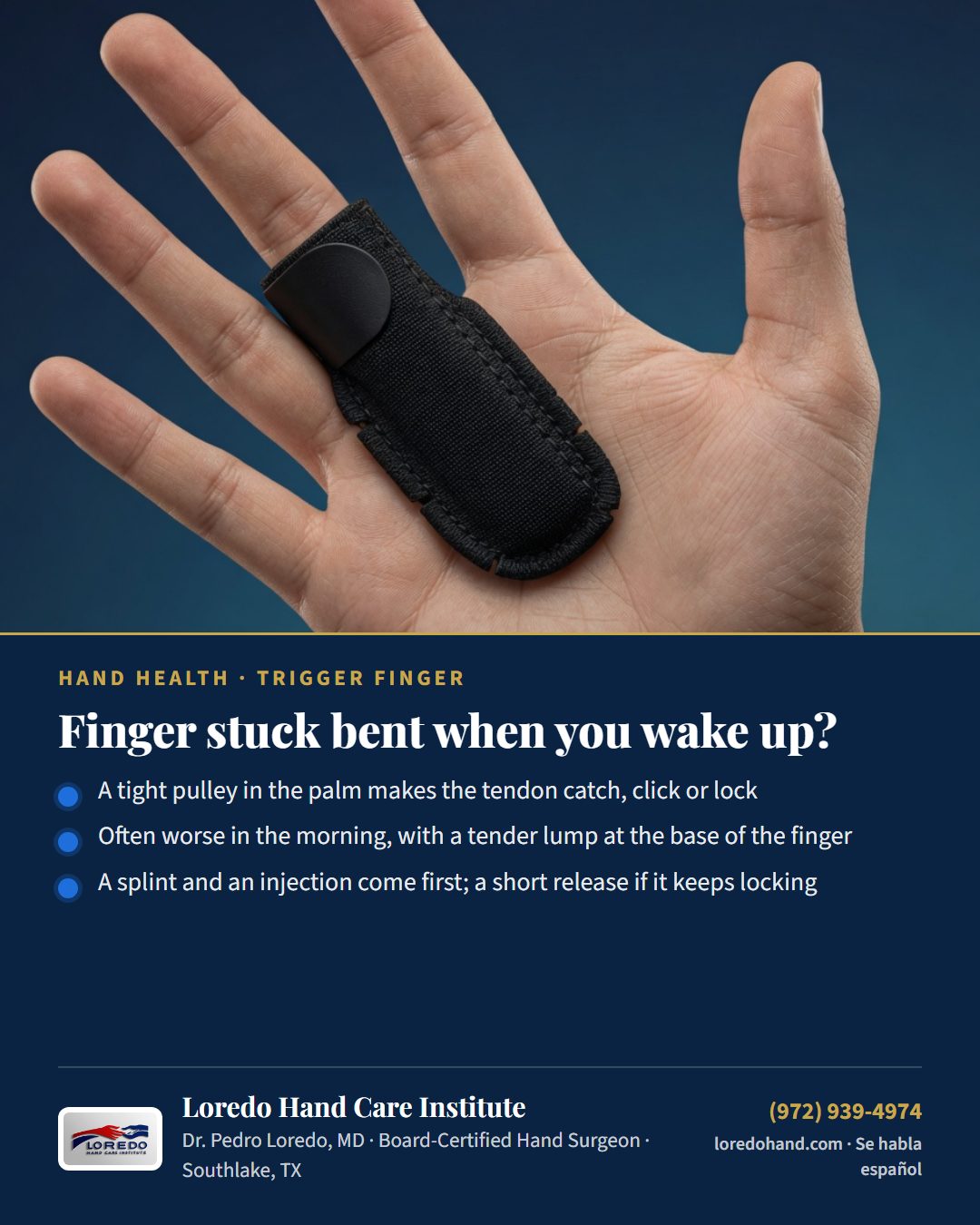
Mild cases often respond to a night splint that keeps the finger straight, gentle tendon-gliding exercises, and a single corticosteroid injection; diabetes can make injections less effective. When the finger keeps locking, Dr. Loredo performs an open A1 pulley release in the office under local anesthesia: a 1 to 2 cm incision in the palm, about 10 to 15 minutes, with the nerves and vessels seen and protected. Patients typically use the hand lightly the same evening, return to desk work in 2 to 5 days, and to heavy gripping in 2 to 4 weeks.
Find this post on: Facebook Instagram YouTube LinkedIn
Questions patients ask
What is trigger finger?
In trigger finger, the tendon that bends the finger no longer glides smoothly through a tight pulley in the palm called the A1 pulley. The finger catches, clicks or locks, and sometimes has to be pulled straight with the other hand. The thumb, ring and middle fingers are affected most often. Repetitive gripping, diabetes, rheumatoid arthritis and hypothyroidism raise the risk, and it is most common between ages 40 and 60.
What are the warning signs of trigger finger?
A finger that catches, clicks or snaps when you bend or straighten it. A tender lump in the palm at the base of the finger. Stiffness and catching that are worse first thing in the morning. A finger that locks bent and must be pushed straight. A finger that no longer fully bends or straightens.
How is trigger finger treated?
Mild cases often respond to a night splint that keeps the finger straight, gentle tendon-gliding exercises, and a single corticosteroid injection; diabetes can make injections less effective. When the finger keeps locking, Dr. Loredo performs an open A1 pulley release in the office under local anesthesia: a 1 to 2 cm incision in the palm, about 10 to 15 minutes, with the nerves and vessels seen and protected. Patients typically use the hand lightly the same evening, return to desk work in 2 to 5 days, and to heavy gripping in 2 to 4 weeks.
Who treats trigger finger near Southlake and Dallas-Fort Worth?
Dr. Pedro Loredo, a board-certified hand surgeon (General Surgery, American Board of Surgery; Hand Surgery, American Board of Plastic Surgery) at Loredo Hand Care Institute, 431 E State Hwy 114, Suite 380, Southlake, TX. New patients are seen within days. Call (972) 939-4974. Se habla español.
En español: ¿Amanece con un dedo trabado y doblado?
En el dedo en gatillo, el tendón que dobla el dedo ya no se desliza bien por una polea apretada en la palma llamada polea A1. El dedo se atora, truena o se traba, y a veces hay que enderezarlo con la otra mano. Los dedos más afectados son el pulgar, el anular y el medio. Agarrar con fuerza de forma repetida, la diabetes, la artritis reumatoide y el hipotiroidismo aumentan el riesgo, y es más común entre los 40 y los 60 años.
Señales de alerta
- Un dedo que se atora, truena o salta al doblarlo o enderezarlo
- Una bolita dolorosa en la palma, en la base del dedo
- Rigidez y trabamiento que empeoran al despertar
- Un dedo que se queda trabado doblado y hay que enderezarlo con la otra mano
- Un dedo que ya no se dobla ni se endereza por completo
Tratamiento
Los casos leves suelen mejorar con una férula nocturna que mantiene el dedo recto, ejercicios suaves de deslizamiento del tendón y una sola inyección de corticosteroide; la diabetes puede hacer que las inyecciones funcionen menos. Si el dedo sigue trabándose, el Dr. Loredo realiza una liberación abierta de la polea A1 en el consultorio con anestesia local: una incisión de 1 a 2 cm en la palma, de unos 10 a 15 minutos, viendo y protegiendo los nervios y vasos. Normalmente se usa la mano de forma ligera esa misma tarde, se vuelve al trabajo de escritorio en 2 a 5 días y a agarrar con fuerza en 2 a 4 semanas.
If this sounds like your hand
Call Loredo Hand Care Institute or start your forms online. New patients are seen within days; surgery, when needed, is scheduled at the first available opening. Se habla español.